Precious Metals Under Pressure:
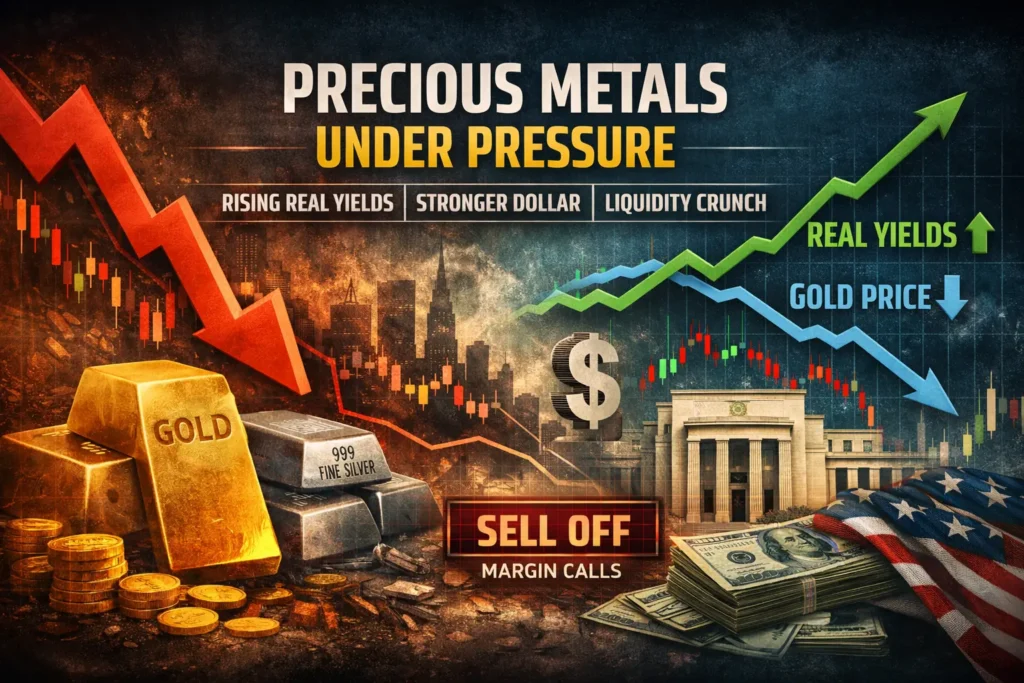
A Macro-Liquidity Reset, Not a Structural Breakdown he recent sell-off across precious metals has been violent, fast, and unsettling. Gold, silver, and related assets have declined sharply, triggering widespread questions about whether the long-term thesis is breaking down. It is not. What we are witnessing is a macro-liquidity reset, driven by real rates, dollar dynamics, and positioning — not a collapse in the structural case for precious metals. 1️⃣ Real yields are reasserting dominance At the core of the move lies a simple but powerful relationship: Gold prices move inversely to real interest rates. Over the past sessions: ➡️ Real yields have moved decisively higher This matters because: This is not a policy shift — it is a repricing of duration and risk-free returns. 2️⃣ The bond market is tightening financial conditions The sell-off in precious metals cannot be understood without the bond market. Key dynamics: This results in: Gold is not being “rejected” — it is being temporarily deprioritized in a world where capital again earns yield. 3️⃣ Dollar liquidity is tightening — quietly This is not about a dramatic dollar surge.It is about dollar scarcity at the margin. Contributing factors include: When dollar liquidity tightens: This is a liquidity hierarchy event, not a confidence crisis. 4️⃣ Positioning: crowded trades unwind brutally Before the sell-off: That combination is dangerous. Once key levels broke: This created a non-linear downside move, entirely mechanical in nature. Importantly:This selling was not based on new information — it was based on risk management rules. 5️⃣ Risk assets absorb liquidity temporarily Despite geopolitical risks and fiscal imbalances: In such phases: This is typical late-cycle behavior — not a signal of systemic stability. 6️⃣ Structural forces remain intact None of the following have changed: Precious metals do not respond linearly to these forces.They respond when confidence breaks, not while it is being temporarily patched. Strategic takeaway This sell-off is best understood as: It is not a repudiation of gold’s role in the global financial system. Historically: The market is currently pricing control.Gold prices instability. Those two states rarely coexist for long. Cartwright Capital perspective Markets are once again prioritizing yield, discipline, and liquidity. That phase tends to: Precious metals are not early-cycle assets.They are systemic insurance. And insurance is always cheapest before it is needed again. Disclaimer This article reflects the author’s opinions and interpretations of publicly available information. It is not investment advice. Investing in commodities and financial markets involves risk, and readers should conduct their own research or consult a licensed financial advisor before making any investment decisions. Sources
Gold in a Relentless Bull Run: Why the Market Is Seeking Safety Again
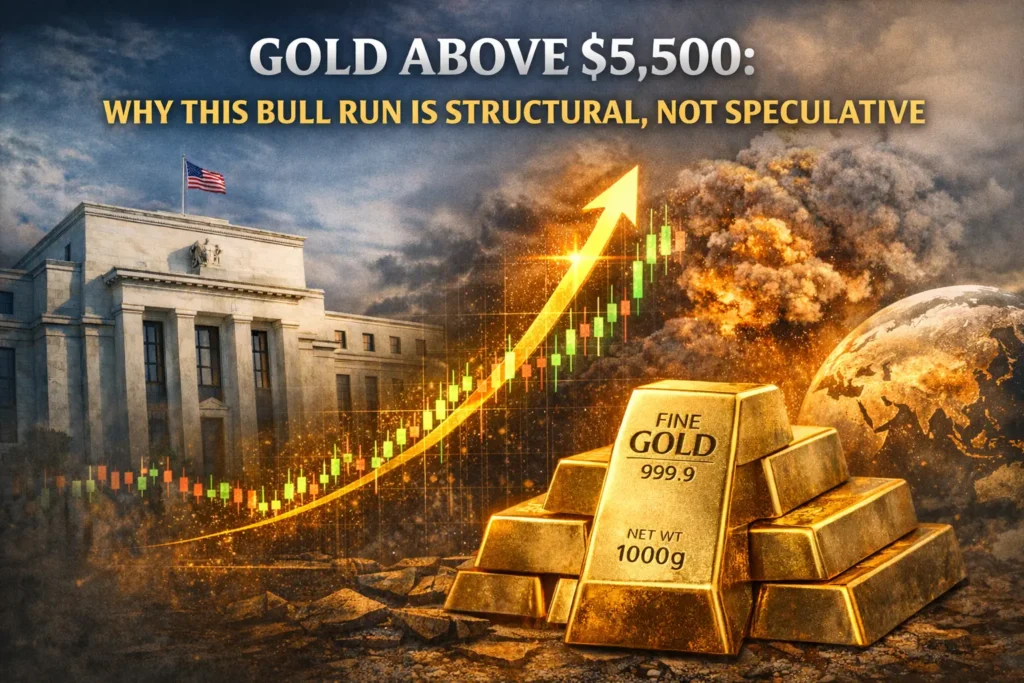
Gold has surged above $5,500 per ounce, marking a historic repricing of the metal. This move is not a technical anomaly, nor a short-term speculative frenzy. It reflects a structural shift in how markets perceive risk, money, and systemic stability. While the magnitude of the rally is extraordinary, the underlying drivers are not new. What has changed is the urgency with which the market is now pricing them in. Real Yields Are Falling — Even at These Price Levels Gold continues to respond to its most reliable macro driver: real interest rates. Despite elevated nominal yields, inflation expectations and debt dynamics are eroding real returns across the curve. Investors are increasingly aware that holding cash or bonds no longer guarantees preservation of purchasing power. At $5,500+, gold is no longer reacting to short-term data points. It is reacting to a loss of confidence in real yield durability. The Fed Has Lost Control of Expectations Federal Reserve The Federal Reserve has not cut rates yet — but that is no longer the point. Markets have concluded that: Gold is pricing the end of credibility, not the next meeting. This Is a Systemic Trade, Not a Fear Spike The rally above $5,500 reflects deep, unresolved structural pressures: Gold is behaving less like a hedge and more like a parallel monetary anchor. Central Banks Are Still Buying — Quietly and Relentlessly One critical element has not changed: central bank demand. These buyers are not price-sensitive in the short term. Their goal is reserve diversification and long-term stability. This creates a permanent bid under the market, limiting downside and amplifying upside when financial capital joins the trade. This is why pullbacks have been shallow — and aggressively bought. Technical Structure: Vertical, but Not Broken From a technical standpoint, gold is in a momentum-driven expansion phase. This does not mean it cannot correct — it means corrections are likely to be sharp, brief, and contained. Key Price Levels (XAUUSD) Primary support zones Resistance / upside targets At these levels, gold is not cheap, but it is doing exactly what it is supposed to do. What This Means for Investors The key takeaway is simple: This is not a speculative bubble — it is a repricing of monetary reality. Short-term corrections are natural and necessary. But as long as real yields remain suppressed and debt dynamics dominate policy decisions, gold retains its strategic role. Gold above $5,500 is no longer a trade.It is a statement about trust in the system. Disclaimer This article reflects the author’s opinions and interpretations of publicly available information. It is not investment advice. Investing in commodities and financial markets involves risk, and readers should conduct their own research or consult a licensed financial advisor before making any investment decisions.
Gold Breaks Above $4,700: A Historic Milestone or Just the Beginning?

Gold prices have surged past $4,700 per ounce, once again confirming their role as a key asset in times of global uncertainty. This move is no random spike—it reflects a powerful mix of macroeconomic pressure, geopolitics, and structural changes in the global financial system. For investors, the signal is clear: gold is firmly back in the spotlight. What’s Driving Gold Higher? 1) Eroding confidence in fiat currenciesRising government debt (especially in the U.S.), persistent deficits, and political pressure on central banks are fueling concerns about the long-term purchasing power of fiat money. Gold benefits in such an environment—it is no one’s liability and cannot be printed. 2) Real interest rates under pressureWhile nominal rates remain relatively high, inflation continues to constrain them. Real yields on bonds are low or volatile, reducing their appeal. In this setting, gold—which pays no interest—becomes a more competitive store of value. 3) Geopolitical risk and a fragmenting worldConflicts in the Middle East, tensions between major powers, and gradual deglobalization are pushing investors toward safe havens. Gold has long been a proven refuge in such times. 4) Central banks as a key driverCentral banks—particularly in emerging markets—continue aggressive gold purchases. The rationale is clear: reserve diversification and reduced reliance on the U.S. dollar. This structural demand provides a strong long-term floor under gold prices. Is $4,700 the Ceiling? In the short term, volatility and pullbacks are natural after such a sharp rally. Profit-taking is to be expected. From a long-term perspective, however, the fundamentals remain compelling.If rate cuts materialize, global debt continues to climb, and geopolitical uncertainty persists, gold has room to stay elevated—and potentially push to new highs. How Should Investors Approach This? In line with the Cartwright Capital philosophy, a few principles apply: Conclusion The move above $4,700 is more than a technical milestone. It reflects deeper structural stresses within the global financial system and serves as a reminder of why gold has preserved value for thousands of years.The key question today is not whether gold belongs in a portfolio—but how much. Disclaimer This article reflects the author’s opinions and interpretations of publicly available information. It is not investment advice. Investing in commodities and financial markets involves risk, and readers should conduct their own research or consult a licensed financial advisor before making any investment decisions. Sources & References Institutional & Official Data Market & Financial Media Analytical & Educational Resources
Gold Holds Below Record Highs After Strong U.S. Data — Still Set for a Weekly Gain
Gold is consolidating just below record highs near $4,600/oz. Strong U.S. labor data lifted the dollar and cooled near-term rate-cut bets. Here’s what matters next. What happened: profit-taking near records, but the uptrend remains intact Gold eased slightly into the end of the week, trading just below the fresh records set earlier in the week. Investing.com reported spot gold around $4,608/oz and futures near $4,611/oz, while still pointing to a weekly rise. Reuters also noted that despite the pullback, gold was on track for roughly a 2% weekly gain after hitting record levels midweek. In plain terms: a short-term pause, not a trend break. 1) The main headwind: strong U.S. data → stronger dollar and higher yields The chain reaction is straightforward: Reuters explicitly connected better-than-expected U.S. labor signals to a firmer dollar and reduced expectations for near-term rate cuts, weighing on gold.Reuters’ broader market wrap also tied improving risk appetite and shifting Fed expectations to USD strength—another headwind for gold. 2) Another headwind: less geopolitical fear = weaker safe-haven bid Gold has benefited from geopolitical risk in recent weeks. When tensions cool even slightly, the immediate safe-haven impulse tends to fade. Reuters mentioned that easing tension around Iran and a softer tone reduced urgent demand for havens.Investing.com similarly framed gold’s pullback as a mix of strong U.S. data and calmer geopolitics keeping prices below records. 3) Why gold is still “holding up” at elevated levels The fact that gold isn’t falling hard after such a strong run is a signal of underlying demand. Commonly cited supports include: A) The market still expects policy easing in 2026 — just not immediately Bloomberg commentary in recent days has highlighted that markets continue to weigh multiple Fed cuts across 2026, though timing shifts with each data release. B) Structural demand: investment hedging motives UBS has maintained a bullish stance in its commentary, citing ongoing demand for hedging against macro and geopolitical risks. C) A classic “post-breakout consolidation” phase FXStreet described the softer tone in gold as consistent with reduced safe-haven demand and more cautious Fed-cut pricing. 4) What to watch next week: an investor/trader checklist If you want an actionable playbook, these are the key triggers: Conclusion: records aren’t the end — they often mark the start of a new phase The picture is consistent across sources: gold is extremely elevated, but still well supported. Strong U.S. data and calmer geopolitics can suppress the safe-haven impulse in the short run. But structural forces—hedging demand and the broader path toward easier policy—keep gold anchored near highs. Bottom line: Disclaimer This article reflects the author’s opinions and interpretations of publicly available information. It is not investment advice. Investing in commodities and financial markets involves risk, and readers should conduct their own research or consult a licensed financial advisor before making any investment decisions. Sources
