A Macro-Liquidity Reset, Not a Structural Breakdown
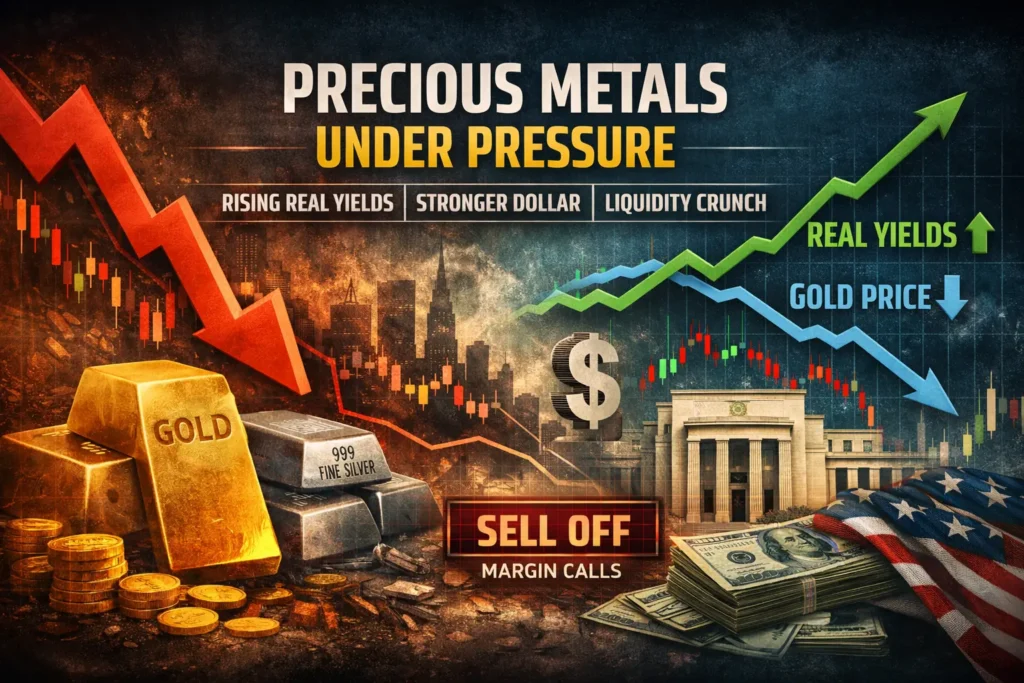
he recent sell-off across precious metals has been violent, fast, and unsettling. Gold, silver, and related assets have declined sharply, triggering widespread questions about whether the long-term thesis is breaking down.
It is not.
What we are witnessing is a macro-liquidity reset, driven by real rates, dollar dynamics, and positioning — not a collapse in the structural case for precious metals.
1️⃣ Real yields are reasserting dominance
At the core of the move lies a simple but powerful relationship:
Gold prices move inversely to real interest rates.
Over the past sessions:
- Nominal yields have remained elevated
- Inflation expectations have stalled or declined
- Central bank credibility has (temporarily) stabilized
➡️ Real yields have moved decisively higher
This matters because:
- Real yields represent the true opportunity cost of holding gold
- When investors can earn positive real returns in sovereign debt, capital shifts accordingly
This is not a policy shift — it is a repricing of duration and risk-free returns.
2️⃣ The bond market is tightening financial conditions
The sell-off in precious metals cannot be understood without the bond market.
Key dynamics:
- Long-end yields remain structurally high
- Yield curve volatility is elevated
- Term premia are being repriced upward
This results in:
- Tighter financial conditions
- Higher discount rates across asset classes
- Reduced tolerance for non-yielding or speculative exposures
Gold is not being “rejected” — it is being temporarily deprioritized in a world where capital again earns yield.
3️⃣ Dollar liquidity is tightening — quietly
This is not about a dramatic dollar surge.
It is about dollar scarcity at the margin.
Contributing factors include:
- Reduced expectations of near-term rate cuts
- Continued quantitative tightening
- Global demand for USD collateral
When dollar liquidity tightens:
- Commodities priced in USD face pressure
- Leveraged positions become more fragile
- Safe-haven demand shifts from gold to cash
This is a liquidity hierarchy event, not a confidence crisis.
4️⃣ Positioning: crowded trades unwind brutally
Before the sell-off:
- Futures positioning in gold and silver was heavily long
- Volatility was suppressed
- Conviction was nearly unanimous
That combination is dangerous.
Once key levels broke:
- Systematic funds reduced exposure
- Volatility-targeting strategies deleveraged
- Margin calls accelerated forced selling
This created a non-linear downside move, entirely mechanical in nature.
Importantly:
This selling was not based on new information — it was based on risk management rules.
5️⃣ Risk assets absorb liquidity temporarily
Despite geopolitical risks and fiscal imbalances:
- Equities continue to attract marginal flows
- Investors favor assets with cash flow and earnings visibility
- Capital rotates toward perceived “growth with yield”
In such phases:
- Hedging assets are sold to fund exposure elsewhere
- Defensive allocations are reduced, not abandoned
This is typical late-cycle behavior — not a signal of systemic stability.
6️⃣ Structural forces remain intact
None of the following have changed:
- Global sovereign debt remains unsustainable
- Fiscal dominance is entrenched
- Monetary policy credibility is fragile
- Demographic and productivity constraints persist
Precious metals do not respond linearly to these forces.
They respond when confidence breaks, not while it is being temporarily patched.
Strategic takeaway
This sell-off is best understood as:
- A real-rate repricing
- A liquidity-driven deleveraging
- A positioning reset
It is not a repudiation of gold’s role in the global financial system.
Historically:
- Precious metals weaken during phases of tightening
- They outperform when tightening reveals something broken
The market is currently pricing control.
Gold prices instability.
Those two states rarely coexist for long.
Cartwright Capital perspective
Markets are once again prioritizing yield, discipline, and liquidity.
That phase tends to:
- punish crowded hedges
- reward patience
- set the stage for the next regime shift
Precious metals are not early-cycle assets.
They are systemic insurance.
And insurance is always cheapest before it is needed again.
Disclaimer
This article reflects the author’s opinions and interpretations of publicly available information. It is not investment advice. Investing in commodities and financial markets involves risk, and readers should conduct their own research or consult a licensed financial advisor before making any investment decisions.
Sources
- Federal Reserve Bank of St. Louis (FRED)
Real Interest Rates, Treasury Yields, Inflation Expectations
https://fred.stlouisfed.org - U.S. Department of the Treasury
Treasury Yield Curve Rates
https://home.treasury.gov/resource-center/data-chart-center/interest-rates - World Gold Council
Gold Demand Trends, Investment Flows, Macro Drivers of Gold
https://www.gold.org - Bank for International Settlements (BIS)
Global Liquidity, Dollar Funding, Financial Conditions
https://www.bis.org - International Monetary Fund (IMF)
Global Financial Stability Report, Fiscal and Debt Dynamics
https://www.imf.org - Bloomberg Markets
Precious Metals Positioning, Bond Market Volatility, Dollar Liquidity
https://www.bloomberg.com/markets - Commitments of Traders (COT) Report – CFTC
Futures Positioning in Gold and Silver
https://www.cftc.gov/MarketReports/CommitmentsofTraders/index.htm - ICE BofA Global Research / BofA Securities
Real Yield Analysis and Asset Allocation Reports
(via institutional research publications) - JP Morgan Asset Management – Market Insights
Macro Cycles, Real Rates and Risk Asset Allocation
https://am.jpmorgan.com/market-insights - BlackRock Investment Institute
Global Outlook, Liquidity Regimes, Portfolio Construction
https://www.blackrock.com/blk-inst-investment-institute
