Weekly Market Recap: What Moved Global Markets (February 2–6, 2026)
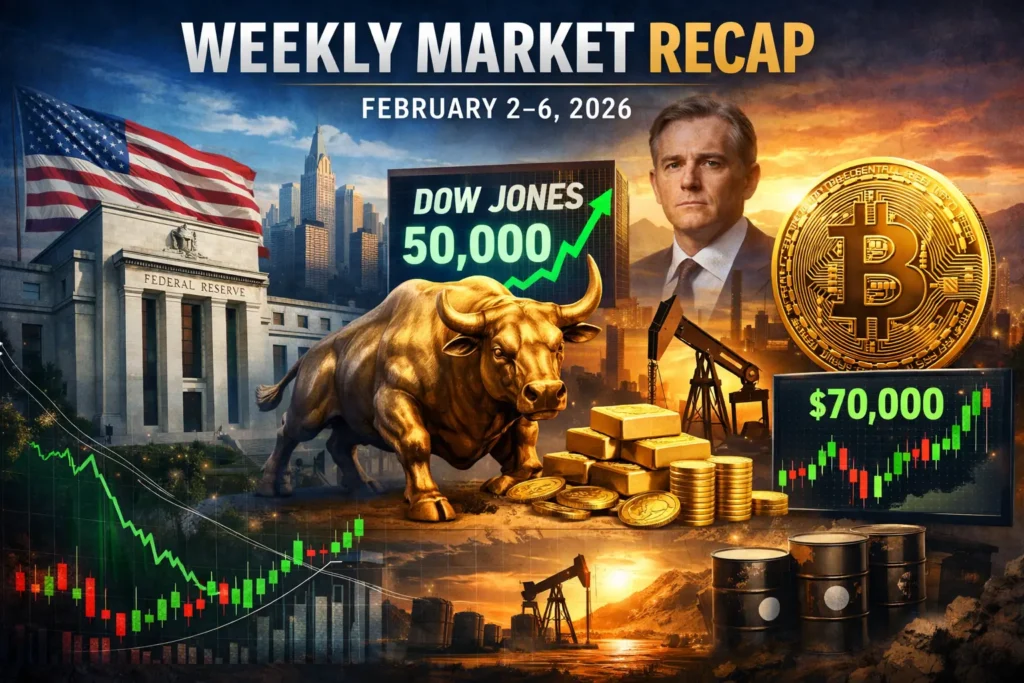
The past week delivered heightened volatility across global financial markets, driven by a mix of monetary policy uncertainty, sharp moves in risk sentiment, and notable fluctuations across equities, commodities, and cryptocurrencies. Investors navigated shifting expectations around the Federal Reserve, strong U.S. dollar dynamics, and rapid price adjustments in both traditional and digital assets. This weekly recap summarizes the key macroeconomic developments, market reactions, and asset-class performance from February 2 to February 6, 2026. Global Macro & Market Environment Market sentiment throughout the week oscillated between risk-off and selective dip-buying. Early in the week, investors reacted cautiously to renewed speculation around U.S. monetary policy leadership and the future trajectory of interest rates. These concerns temporarily strengthened the U.S. dollar and pressured commodities and risk assets. As the week progressed, markets began stabilizing, with Friday delivering a sharp rebound across several asset classes. The result was a week defined less by a single trend and more by rapid sentiment shifts and elevated volatility. Equity Markets: Volatility Followed by Recovery United States U.S. equities experienced significant turbulence mid-week, with broad sell-offs driven by risk aversion and profit-taking, particularly in technology stocks. However, Friday’s session marked a strong turnaround: Despite the late-week rally, investor positioning remains cautious, with markets highly sensitive to upcoming macro data and Fed-related signals. Europe & Canada European equities showed mixed performance, with some indices holding near record levels despite broader market uncertainty. In Canada, the TSX Composite Index recorded its strongest daily gain in several months, supported primarily by a rebound in metal prices and improved sentiment toward resource stocks. Commodities: Gold and Oil in Focus Gold and Precious Metals Precious metals faced significant downward pressure during the first half of the week. Gold prices declined sharply as the U.S. dollar strengthened and markets reassessed the outlook for U.S. monetary policy. Key drivers included: Toward the end of the week, gold staged a modest technical rebound, suggesting that some investors began re-entering positions after the sharp correction. Weekly takeaway: gold experienced a pronounced sell-off, followed by stabilization and early signs of recovery. Oil Oil prices traded in a volatile but largely range-bound fashion: Overall, crude oil ended the week without a clear directional trend but remained highly sensitive to geopolitical and macroeconomic headlines. Cryptocurrencies: High Volatility and Sharp Rebound Cryptocurrency markets once again behaved as high-beta risk assets, closely tracking broader risk sentiment: Ethereum and other major cryptocurrencies followed a similar pattern, underscoring the sector’s continued sensitivity to macro conditions and investor risk appetite. Federal Reserve & Monetary Policy Uncertainty A key macro theme this week was uncertainty surrounding the future leadership of the Federal Reserve, particularly speculation around a potential nomination of Kevin Warsh as Fed Chair. Markets interpreted this development as potentially more hawkish, contributing to: While no immediate policy changes are expected, sentiment remains fragile and highly reactive to any signals regarding future rate decisions. Key Macroeconomic Data Several data points contributed to short-term market movements: Key Takeaways from the Week Disclaimer This article reflects the author’s opinions and interpretations of publicly available information. It is not investment advice. Investing in commodities and financial markets involves risk, and readers should conduct their own research or consult a licensed financial advisor before making any investment decisions. Sources
Weekly Market Recap: Geopolitics, Monetary Policy and a Reality Check for Risk Assets
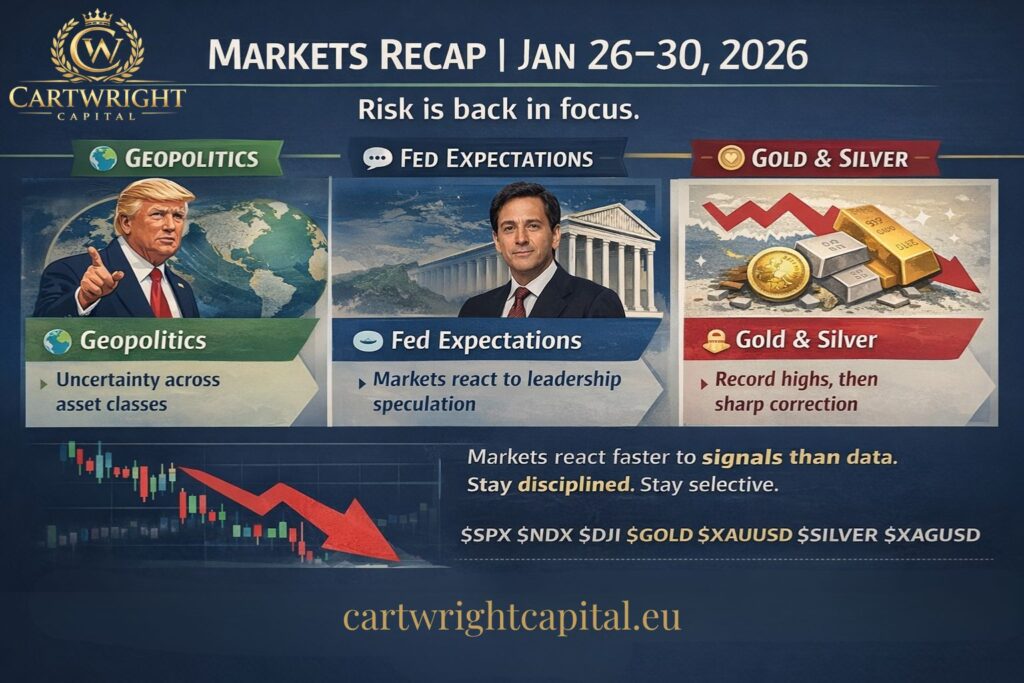
January 26–30, 2026 The final week of January delivered a powerful reminder of how fragile market sentiment remains in 2026. Geopolitical tensions, renewed uncertainty around U.S. monetary policy, and extreme volatility in precious metals combined to unsettle investors across asset classes. From record-breaking rallies to abrupt sell-offs, markets were driven less by hard data and more by expectations, political signaling, and positioning. 🌍 Global Context: Politics Back at the Center of Markets Geopolitics reasserted itself as a dominant market driver. The Trump administration continued to apply a confrontational tone toward international partners, including renewed trade rhetoric and strategic pressure on allies. While no immediate policy shifts were enacted, the uncertainty premium embedded in markets increased noticeably. At the same time, discussions at the World Economic Forum in Davos highlighted a growing disconnect between political ambitions and economic realities. Calls for cooperation, technological investment, and stability contrasted sharply with the rising fragmentation of global trade and diplomacy. For investors, the message was clear: political risk is no longer a tail risk—it is a core input in asset pricing. 🇺🇸 The Federal Reserve Question: Expectations Drive Volatility One of the most influential narratives of the week revolved around speculation regarding the future leadership of the Federal Reserve. Reports suggesting that President Trump favors Kevin Warsh as a potential future Fed Chair triggered a sharp reassessment of interest rate expectations. While no official appointment has been made, markets interpreted the signal as a possible shift toward a more hawkish monetary stance. The immediate consequences were visible: This episode once again demonstrated that markets react not to decisions, but to perceived trajectories. 📈 Equity Markets: Stability on the Surface, Fragility Underneath Equity markets delivered mixed signals throughout the week. Overall, equities did not collapse—but they stopped ignoring risk. 🪙 Gold and Silver: From Euphoria to Liquidation Precious metals experienced one of the most dramatic weeks in recent history. Early Week: Safe-Haven Surge Driven by geopolitical anxiety and falling confidence in policy stability: Late Week: Violent Reversal As expectations around Fed leadership and rate policy shifted: 🧠 What This Week Really Means Investment Insight – Cartwright Capital “This week was not about fundamentals—it was about positioning and confidence. Gold and silver didn’t collapse because the long-term thesis disappeared. They corrected because markets had priced in perfection. On the equity side, investors are beginning to differentiate again. Cash flow, balance sheet strength, and valuation discipline matter more than narratives. The key takeaway: volatility is not a threat—it’s a signal. And in 2026, signals matter more than forecasts.” 🔍 Strategic Takeaways for Investors 🧾 Conclusion The week of January 26–30, 2026, reminded investors of a simple truth:markets are no longer driven by optimism alone. In an environment shaped by geopolitics, monetary uncertainty, and elevated valuations, discipline is replacing momentum. Those who adapt will survive volatility.Those who ignore it will be surprised by it. Disclaimer This article reflects the author’s opinions and interpretations of publicly available information. It is not investment advice. Investing in commodities and financial markets involves risk, and readers should conduct their own research or consult a licensed financial advisor before making any investment decisions. Sources
Weekly Market Recap (January 19–23, 2026)

Geopolitics Takes the Lead as Gold Shines and Equities Turn Cautious The past week made one thing clear: financial markets in 2026 are being driven more by geopolitics than by traditional macroeconomic data. Political statements, strategic tensions, and uncertainty around global leadership have once again reshaped investor behavior across equities, commodities, and safe-haven assets. The period from January 19 to January 23, 2026 was a textbook example of this shift. 🌍 Geopolitics: The Dominant Market Force Investor attention was once again drawn to statements from U.S. President Donald Trump, whose rhetoric continues to inject uncertainty into global markets. Tariffs, Power Politics, and Market Risk Renewed threats of tariffs, protectionist messaging, and challenges to multilateral cooperation increased market anxiety—particularly in export-dependent economies and cyclical sectors. Markets quickly repriced risk as investors reassessed global trade stability. Greenland: More Than a Headline The renewed focus on Greenland may sound symbolic, but it highlights deeper strategic issues: For markets, this reinforces a key message: geopolitical stability can no longer be taken for granted. 🏦 Federal Reserve: Silence Under Scrutiny While the Federal Reserve made no new policy decisions this week, markets remained highly sensitive to discussions around: Investors increasingly view monetary policy not only as an economic tool, but also as a political variable—an important shift in market psychology. 📉 Equities: Momentum Slows, Selectivity Returns Global equity markets did not collapse—but they clearly lost momentum. United States U.S. indices traded sideways to slightly lower as investors: Technology stocks proved particularly sensitive to trade and regulatory headlines. Europe European equities underperformed due to: ➡️ The key theme: markets are no longer indiscriminate buyers. Quality, balance sheets, and cash flow are back in focus. 🪙 Gold: Safe Haven Demand Strengthens Gold was one of the clear winners of the week. Drivers behind gold’s strength: Gold continues to behave as expected in uncertain environments—not as a speculative asset, but as strategic portfolio insurance. 🛢️ Oil: Geopolitical Premium vs. Economic Reality Oil prices balanced between two opposing forces: Geopolitical Support Demand Concerns The result: a firm but volatile oil market, acting as a real-time barometer of geopolitical risk. 🧠 Key Takeaways for Investors 🔚 Conclusion This week was not defined by a single economic release, but by a shift in sentiment. Investors are being reminded that capital preservation matters as much as growth—and that resilience is becoming a defining investment theme of this cycle. Disclaimer This article reflects the author’s opinions and interpretations of publicly available information. It is not investment advice. Investing in commodities and financial markets involves risk, and readers should conduct their own research or consult a licensed financial advisor before making any investment decisions. Sources
Weekly Market Recap: What Moved Markets From January 12 to 16, 2026
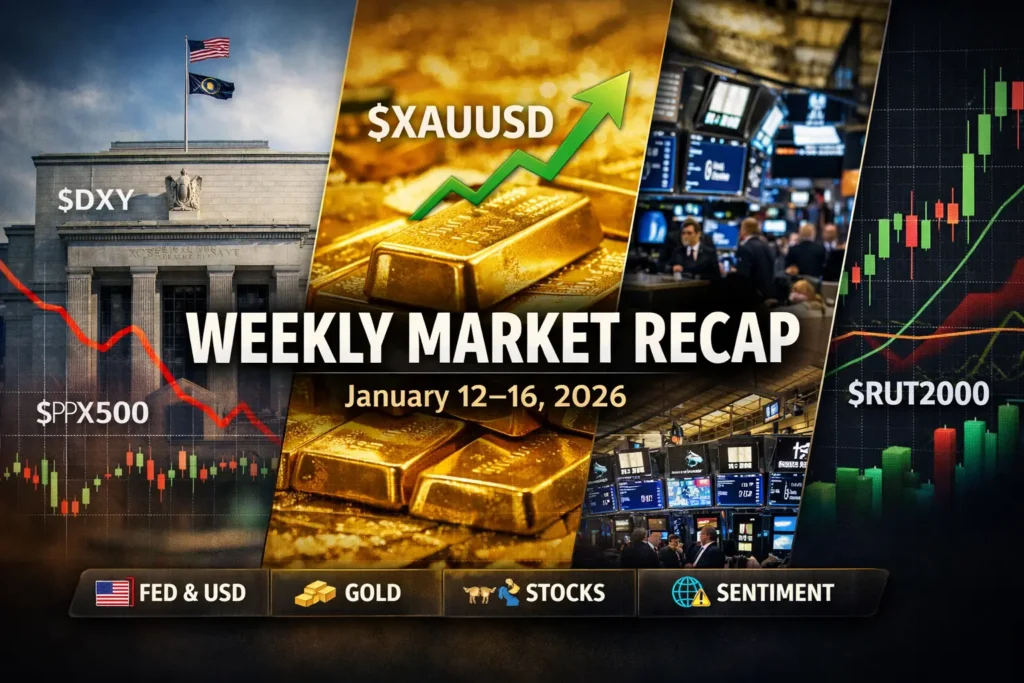
The past week delivered a powerful reminder of how sensitive global markets remain to political risk, central bank credibility, and macroeconomic uncertainty. From mounting pressure on the Federal Reserve to record-breaking moves in gold, investors were forced to reassess risk across asset classes. Here is a clear and structured overview of what mattered most. 1) Macro & Central Banks: Fed Independence in the Spotlight Pressure on the Federal Reserve Shakes Market Confidence The dominant macro theme of the week was growing political pressure on the U.S. Federal Reserve. News surrounding scrutiny of the Fed’s leadership raised concerns about the long-term independence of the central bank — a cornerstone of global financial stability. Markets reacted quickly: While the investigation itself is administrative in nature, investors interpreted the situation as a systemic risk, not a short-term headline. Interest Rate Expectations Remain Cautious Despite political noise, expectations for U.S. interest rates remained relatively stable. Markets continue to price in a “higher-for-longer” environment, with potential rate cuts pushed further into the second half of 2026 — contingent on inflation data and economic momentum. 2) Equity Markets: Volatility and Sector Rotation Major Indexes End the Week Lower U.S. equity markets struggled to find clear direction: The start of earnings season failed to provide a strong catalyst, keeping sentiment cautious. Small-Cap Stocks Outperform In contrast, small-cap stocks outperformed, with the Russell 2000 index reaching new highs. This suggests a rotation away from mega-cap technology toward: This divergence is an important signal for portfolio positioning. 3) Commodities: Gold Dominates the Narrative Gold Reaches New All-Time Highs Gold was the clear winner of the week. Driven by: gold prices surged to new record levels before experiencing a mild pullback toward the end of the week. Importantly, the correction appeared technical rather than fundamental, with prices remaining well above key support levels. Why Gold Matters Now Gold once again proved its role as: For long-term investors, this reinforces gold’s strategic — not speculative — value. 4) Global Sentiment & Economic Outlook Investor Sentiment: Cautious, Not Panicked Despite heightened uncertainty, markets did not enter a risk-off spiral. Instead, sentiment can best be described as: Inflation Risks Remain Underestimated Several macro analysts warned that inflation risks in 2026 may be underpriced, particularly if political interference weakens monetary discipline. This scenario would further support real assets and defensive positioning. 5) Key Takeaways From the Week Asset / Theme Weekly Insight Federal Reserve Political pressure raises systemic concerns U.S. Equities Modest declines, elevated volatility Small Caps New highs, strong relative performance Gold Record levels, confirms safe-haven status U.S. Dollar Weakened amid institutional uncertainty Final Thoughts for Investors The week of January 12–16 highlighted a critical theme for 2026: confidence in institutions matters. When that confidence is questioned, capital moves quickly toward safety. Gold’s performance was not accidental — it was a rational response to uncertainty. Meanwhile, equity markets are increasingly selective, rewarding balance sheet strength and penalizing excess optimism. As we move forward, investors should remain focused on: Disclaimer This article reflects the author’s opinions and interpretations of publicly available information. It is not investment advice. Investing in commodities and financial markets involves risk, and readers should conduct their own research or consult a licensed financial advisor before making any investment decisions. Sources The analysis above is based on publicly available information from reputable financial media and market data sources.
