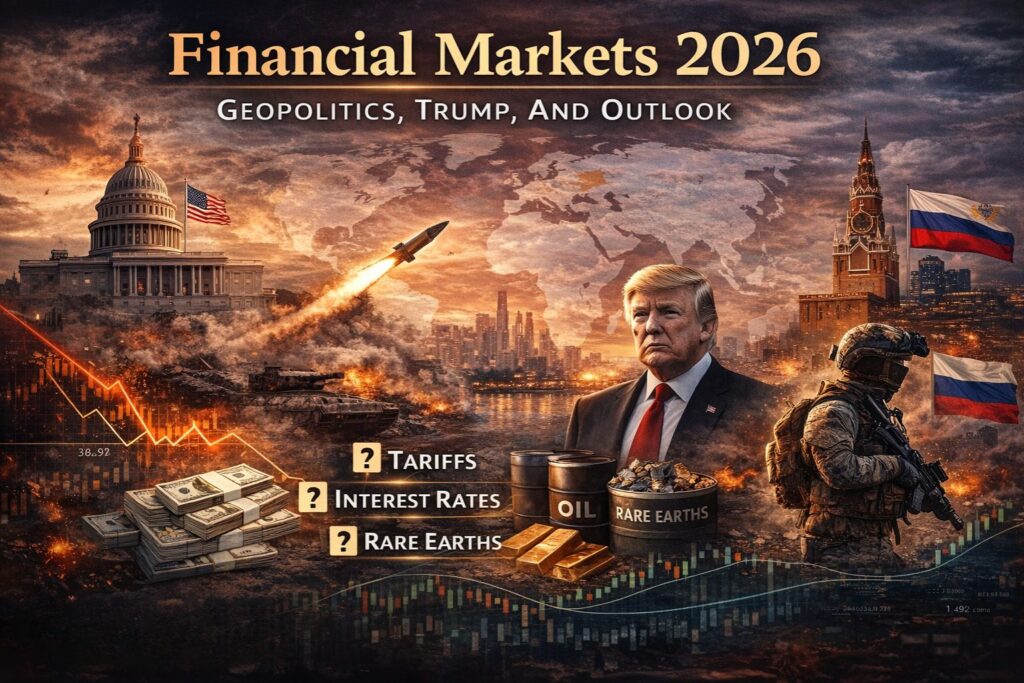
1. 2025 Recap: Unexpectedly Strong Growth
2025 was a wild year for investors, but ultimately very profitable. Despite a challenging geopolitical environment, the markets demonstrated immense resilience.
Market Performance: The US S&P 500 index finished the year near its highs with a gain of approximately 16%, outperforming the long-term average (10.8%).
Trump’s Tariff Policy: Markets had to contend with Donald Trump’s aggressive tariff policy, as he adjusted tariff schedules against the entire world. In April 2025, this even triggered a short-term slump (a so-called “Swift Bear Market”), but indices recovered quickly once Trump shifted to a more consensual rhetoric.
Economic Growth: Despite high rates and debt, the US economy grew by 1.8–2%, dispelling fears of a recession.
2. Geopolitics in 2026: Spheres of Influence and the Law of the Strongest
The main theme for 2026 isn’t pure economics, but rather aggressive US geopolitics.
New US Doctrine: America is resigning from “soft power” and international institutions (UN). Instead, it is carving out spheres of influence where it applies the law of the strongest. This is a message to both China and Russia.
Intervention in Venezuela: A major event at the start of 2026 is the US military intervention in Venezuela against Maduro. The goal is to install a pro-American government, restore oil production (companies like Chevron, Exxon), and drive global oil prices down.
Message to China and Russia: The swift operation in Venezuela is intended to show China (in the context of Taiwan) and Russia the efficiency of the US military, in contrast to the protracted war in Ukraine.
3. War in Ukraine: No Peace in Sight
Initial expectations that Trump would quickly end the war proved to be unfounded.
Russian Ambitions: Russia does not want to give up territory, and its goal remains the curtailment of Ukraine or the creation of a puppet state.
Ukrainian Position: Zelensky refuses peace at any cost. The main sticking points are: The Zaporizhzhia Nuclear Power Plant, Donbas, and security guarantees (Russia refuses the presence of Western troops in Ukraine).
Investment Impact: The European defense sector, which underwent a correction in hopes of peace, may become attractive again as the conflict is set to continue.
4. Macroeconomic Outlook: Inflation vs. Deflation
The US economy is experiencing an interesting dichotomy between sectors and conflicting inflationary pressures.
Manufacturing vs. Services: The manufacturing sector (in the US, China, and Germany) is in contraction. The economy is being driven by services. Czech industry only emerged from a long recession at the end of 2025.
Labor Market: Cooling is occurring. Unemployment in the US rose to 4.5%, which is still a historically low and healthy figure that helps dampen wage inflation.
Clash of Inflationary Influences:
Pro-inflationary: Trump’s tariffs and protectionism make goods more expensive.
Anti-inflationary: Oil prices. Due to pressure on production (Venezuela) and weaker demand from China, oil could fall by another 10–15%. This acts as a positive supply shock.
5. The Fed and Interest Rates
The Fed is cutting rates, perhaps faster than is healthy, under pressure from the White House.
Politicization of the Fed: Donald Trump is unhappy with Jerome Powell and is looking for someone to lead the Fed who will be “accommodating” to his policy of low rates and a weaker dollar.
The Dollar: Weakening due to massive US deficits and expectations of lower rates.
6. Risks for Investors (What to Watch)
Although the baseline scenario for 2026 is positive (continued growth), specific risks exist:
Rare Earth Elements: China controls 90% of rare earth processing. Reports are emerging that China is restricting supplies to the US, which is a weak point for American industry.
Return of Inflation: If tariffs outweigh the effect of cheap oil, inflation could begin to “spike,” forcing markets into a correction.
Conclusion for the Article
The blog post should strike a cautiously optimistic tone: “We enter 2026 with a growth outlook, but with a finger on the trigger due to geopolitics.” Markets have become accustomed to Trump’s style of “threat – negotiation – deal,” but real risks lurk in supply chains (China) and on battlefields where America has decided to act with force.
Disclaimer: This article is for informational and educational purposes only and reflects personal analysis and opinions. It does not constitute financial, investment, or trading advice. Always do your own research and consider your individual circumstances before making any investment decisions.
