Introduction: when history starts to rhyme
Financial markets rarely repeat themselves precisely, but they often rhyme. One of the most frequently cited historical parallels in today’s macroeconomic debate is the mid-1980s — a period marked by an exceptionally strong US dollar, rising global imbalances, and ultimately a coordinated policy response that reshaped currency markets for years.
The year 1985 stands as a reference point not because of a crisis, but because of a deliberate intervention that acknowledged structural imbalance. As the global economy once again navigates a phase of dollar dominance, the comparison is becoming increasingly relevant.
The setup: why the dollar became too strong in the early 1980s
In the early 1980s, the US dollar surged dramatically. The drivers were clear:
- aggressive interest rate hikes under Paul Volcker
- capital inflows seeking yield and stability
- declining inflation expectations in the United States
Between 1980 and 1985, the dollar appreciated by more than 50% against major currencies such as the Japanese yen and the German mark. While this helped tame inflation, it created severe trade distortions.
US exports became uncompetitive, manufacturing pressure intensified, and trade deficits ballooned. The strong dollar had fulfilled its monetary role — but overstayed its economic welcome.
The Plaza Accord: a controlled reset, not a panic
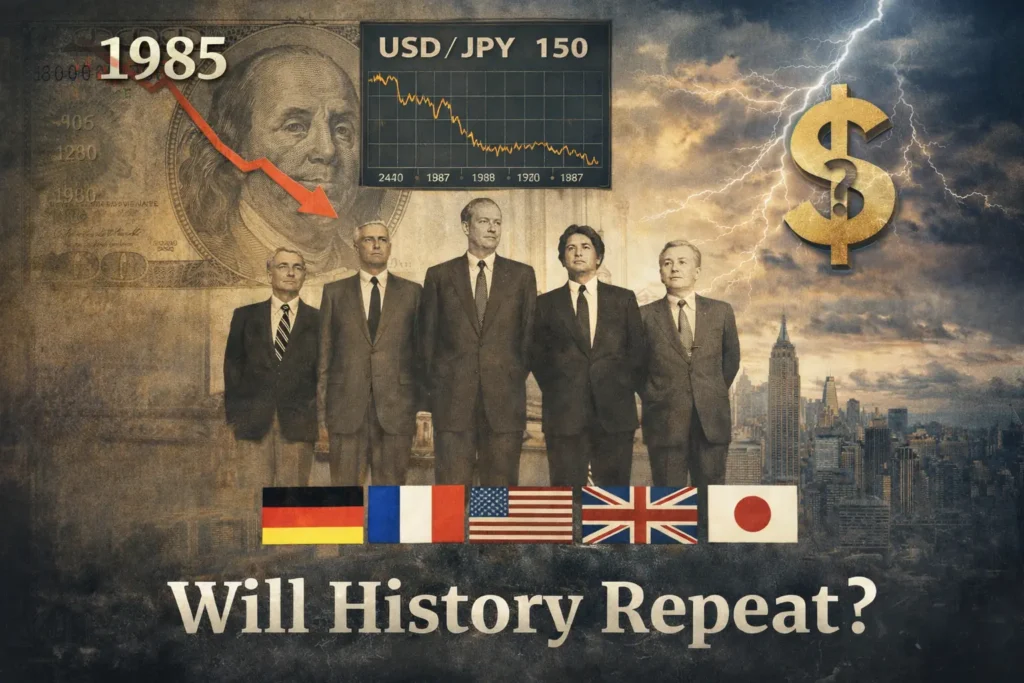
In September 1985, finance ministers and central bank governors from the United States, Japan, West Germany, France, and the United Kingdom met in New York. The outcome became known as the Plaza Accord.
The agreement’s objective was explicit:
- coordinate foreign exchange intervention
- engineer a gradual depreciation of the US dollar
- restore global trade balance
The result was historic. Over the following two years:
- the dollar weakened by roughly 30–40%
- USD/JPY fell from around 240 to near 150
- currency volatility remained surprisingly contained
Crucially, this was not a market-driven collapse, but a policy-managed adjustment.
Consequences: second-order effects mattered more than the headline
While the dollar’s decline itself was orderly, the secondary consequences were profound — particularly for Japan.
A sharply stronger yen pushed Japanese policymakers toward aggressive monetary easing. The outcome was one of the largest asset bubbles in modern history, culminating in the equity and real estate collapse of the early 1990s and Japan’s subsequent “lost decades.”
This remains a critical lesson:
Currency realignments rarely end with currencies.
Fast forward to today: familiar conditions, different system
At first glance, today’s environment shares notable similarities with 1985:
| Factor | Mid-1980s | Today |
|---|---|---|
| USD strength | Extreme | Elevated |
| Interest rates | High | Restrictive |
| Trade deficits | Rising | Structurally large |
| Capital inflows | Yield-driven | Yield + safety-driven |
| Global tensions | Moderate | High |
However, the differences are equally important.
Today’s financial system is:
- vastly more interconnected
- dominated by ETFs and passive flows
- leveraged through derivatives and cross-currency funding
Moreover, the US fiscal position is significantly weaker, and the dollar’s role extends far beyond trade — it is embedded in global debt markets.
Why a “Plaza Accord 2.0” would look very different
Unlike in 1985, a coordinated dollar depreciation today would face major constraints:
- central bank independence limits political coordination
- geopolitical fragmentation complicates consensus
- a weaker dollar directly impacts global debt servicing
As a result, any future dollar adjustment is more likely to be:
- gradual
- indirect
- driven by relative growth, inflation differentials, and capital allocation rather than formal agreements
The absence of a Plaza-style announcement does not preclude a multi-year realignment — it simply changes the transmission mechanism.
What history suggests — without predicting outcomes
The lesson of 1985 is not that the dollar must weaken, but that currency dominance has limits.
Historically:
- periods of extreme dollar strength tend to self-correct
- corrections unfold over years, not weeks
- equity markets can adapt faster than currencies
For globally diversified portfolios, currency becomes less about timing and more about structural awareness.
Conclusion: awareness over anticipation
The events of 1985 demonstrate that major currency shifts do not require panic to be impactful. They emerge when economic realities force adjustment, often under the guise of stability.
Whether today’s dollar strength leads to a similar inflection point remains uncertain. What is clear is that currency dynamics operate on longer cycles than most investors expect, and their influence extends far beyond exchange rates alone.
History may not repeat itself — but it continues to offer a valuable framework for understanding what lies ahead.
Disclaimer
This article reflects the author’s opinions and interpretations of publicly available information. It is not investment advice. Investing in commodities and financial markets involves risk, and readers should conduct their own research or consult a licensed financial advisor before making any investment decisions.
Sources
Historical & Policy Background
- U.S. Department of the Treasury – The Plaza Accord (1985)
Official historical overview of the agreement and its objectives. - Federal Reserve Bank of St. Louis (FRED)
Historical data on USD exchange rates, interest rates, and macroeconomic indicators. - International Monetary Fund (IMF) – World Economic Outlook (historical editions)
Global imbalances, exchange rate coordination, and macro policy context.
Currency Markets & FX Impact
- Bank for International Settlements (BIS)
Annual Economic Reports – long-term analysis of currency interventions and dollar cycles. - OECD – Exchange Rate Developments and Global Imbalances
Comparative studies on coordinated currency policies. - Federal Reserve – Trade-Weighted U.S. Dollar Index (Broad)
Long-term USD strength and reversal periods.
Academic & Financial Analysis
- Eichengreen, Barry – Globalizing Capital: A History of the International Monetary System
Authoritative academic reference on Plaza Accord and its aftermath. - Obstfeld, Maurice & Rogoff, Kenneth – Foundations of International Macroeconomics
Currency coordination, balance-of-payments dynamics. - Journal of Economic Perspectives – The Plaza Accord: Lessons for Today (various retrospectives)
Market Commentary & Modern Parallels
- Financial Times – Analysis articles on dollar dominance, global trade imbalances, and policy coordination.
- The Economist – Dollar dominance, Currency wars, and historical comparisons.
- Bloomberg Macro & FX Commentary
Analysis of current USD strength, de-dollarization narratives, and policy risks.
Equity & Investor Perspective
- MSCI – Currency Effects on Equity Returns
Impact of USD moves on international equity performance. - Vanguard Research – The Role of Currency in Portfolio Returns
Long-term investor-focused analysis.
