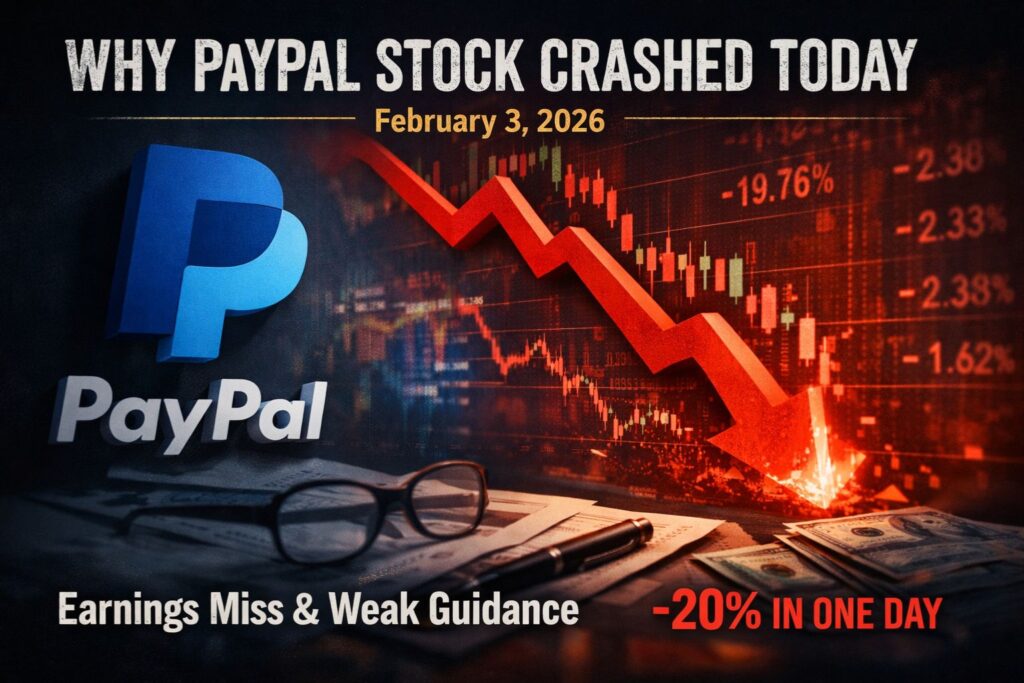
Date: February 3, 2026
Ticker: PayPal (PYPL)
Closing price (intraday): ~42 USD
Daily move: ~-20%
A market wake-up call, not a random sell-off
PayPal shares suffered one of their sharpest single-day declines in years, plunging close to 20% after the company reported earnings. While the headline numbers were weaker than expected, the true reason behind the sell-off runs deeper. This was not merely a “bad quarter” reaction — it was a full valuation reset.
In short, the market stopped treating PayPal as a growth-oriented fintech and began pricing it as a mature, slow-growth payments company.
1. Earnings missed — but that alone wasn’t the problem
Yes, PayPal underdelivered:
- Revenue came in slightly below expectations
- Earnings per share failed to excite
- Growth metrics continued to decelerate
Under normal circumstances, such a miss might have caused a 5–8% pullback. Instead, the stock collapsed nearly 20%. That tells us one thing clearly: the miss was only the trigger, not the core issue.
2. Guidance shock: the real catalyst
The decisive blow came from management’s forward guidance.
PayPal signaled:
- Slower growth ahead
- Limited near-term margin expansion
- No clear acceleration story for 2026
Markets are forward-looking, and what investors heard was simple:
“The next phase will not look materially better than the last.”
For a stock still carrying remnants of a growth multiple, that was unacceptable.
3. The “growth illusion” finally broke
For years, PayPal benefited from its legacy status as a fintech pioneer. Even as growth slowed, the market was willing to believe that:
- monetization would improve,
- margins would recover,
- innovation would reignite growth.
This earnings release effectively killed that narrative.
Once investors accepted that PayPal’s business resembles a stable — but unexciting — payments processor, the valuation had to adjust accordingly.
That adjustment happened in one brutal session.
4. Competitive pressure is no longer theoretical
PayPal now operates in a landscape dominated by:
- Apple Pay and ecosystem-driven wallets,
- Stripe and Adyen on the merchant side,
- buy-now-pay-later platforms squeezing checkout economics.
The company’s core product — branded checkout — is no longer a clear moat. Growth is increasingly driven by promotions rather than organic demand, putting sustained pressure on margins.
The market no longer views this as temporary.
5. Technical damage accelerated the sell-off
From a technical perspective, the stock broke:
- long-term support levels,
- key moving averages,
- and previous cycle lows.
Once those levels failed, algorithmic and institutional selling accelerated the decline. Volume spiked, confirming that this was not retail panic but professional de-risking.
In such moments, price moves faster than fundamentals — and it did.
6. A brutal but honest re-rating
At around 42 USD, PayPal now trades closer to:
- value-oriented multiples,
- low-growth assumptions,
- and conservative future cash-flow expectations.
This does not mean PayPal is broken as a business. It remains profitable, cash-generative, and operationally solid. But it does mean that the market has removed the benefit of the doubt.
What investors should take away
This was not a one-day overreaction. It was the market acknowledging reality.
PayPal fell because:
- Earnings disappointed
- Guidance removed hope for near-term acceleration
- Growth expectations collapsed
- Competitive pressures are intensifying
- Valuation no longer made sense under the new narrative
Whether the stock stabilizes or continues lower will depend not on promises, but on execution, margin discipline, and proof of relevance in a crowded payments ecosystem.
Final thought from Cartwright Capital
“Markets are unforgiving when a company transitions from growth to maturity. PayPal didn’t just miss expectations — it lost its story.”
For long-term investors, this reset may eventually create opportunity. But in the short term, the message is clear: the market is no longer willing to wait.
Disclaimer
This article reflects the author’s opinions and interpretations of publicly available information. It is not investment advice. Investing in commodities and financial markets involves risk, and readers should conduct their own research or consult a licensed financial advisor before making any investment decisions.
