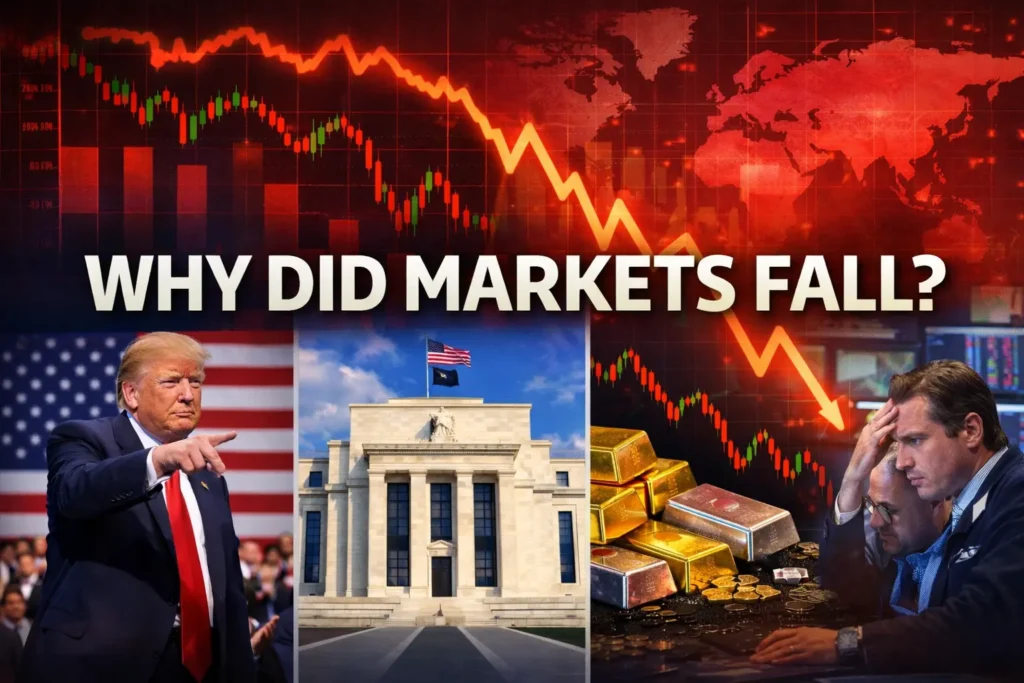
Global equity markets had a weak week, reminding investors that 2026 is unlikely to be a smooth, one-directional rally. The sell-off was not triggered by a single dramatic event. Instead, it was driven by a combination of political uncertainty, monetary policy expectations, and a long-overdue reassessment of risk.
Here are the key factors behind the move.
1️⃣ Politics: Trump Back in the Market Narrative
One of the main sources of renewed uncertainty is the growing political relevance of Donald Trump. Markets are not reacting to polling numbers alone, but to the implications of a realistic Trump return to power.
Investors are increasingly pricing in:
- the risk of new trade tariffs and renewed trade conflicts (China, EU),
- pressure on institutions and global alliances,
- a more unpredictable foreign and economic policy framework.
Markets dislike uncertainty more than bad news. A wider range of political outcomes automatically means a higher risk premium for equities.
2️⃣ The Federal Reserve: Higher Rates for Longer
Another critical factor was communication from the Federal Reserve. While no new Fed leadership has been appointed, the tone of recent messaging has been enough to unsettle markets.
The key takeaway:
- inflation progress remains uneven,
- rate cuts are not imminent,
- policy is likely to stay restrictive longer than markets previously assumed.
This matters because:
- higher interest rates increase discount rates for equities,
- future earnings become less valuable in today’s terms,
- growth and technology stocks suffer the most.
3️⃣ Bond Markets Are Sending a Warning
One of the strongest signals did not come from equities, but from bonds.
- U.S. Treasury yields moved higher again
- The long end of the yield curve remains elevated
- Rising Japanese yields signal a gradual end to ultra-cheap global liquidity
In simple terms:
👉 capital is no longer cheap
👉 risk assets must adjust
Equities are now catching up with what bond markets have been signaling for weeks.
4️⃣ Valuations Were Stretched
It is important to keep context in mind. Markets had rallied strongly before this pullback.
- AI-related stocks became crowded trades,
- valuations often assumed near-perfect scenarios,
- margin of safety was thin.
Once higher rates and political uncertainty re-entered the equation, profit-taking was inevitable. This was not panic selling—it was a rational reset.
5️⃣ Market Psychology: From Optimism to Caution
Markets move in cycles:
- optimism → risk ignored
- correction → reality returns
The current phase reflects a shift away from narratives and toward fundamentals:
- cash flow,
- balance sheet strength,
- interest-rate sensitivity.
This transition tends to be uncomfortable—but healthy.
What This Means for Investors
👉 This does not signal the end of the bull market, but rather a change in regime.
👉 In 2026, politics and central banks will matter as much as corporate earnings.
👉 Quality, diversification, and cash flow are back in focus.
Assets such as gold, defensive equities, dividend payers, and companies with strong balance sheets are regaining relevance. Blindly chasing growth without regard to valuation or rates carries increasing risk.
Disclaimer
This article reflects the author’s opinions and interpretations of publicly available information. It is not investment advice. Investing in commodities and financial markets involves risk, and readers should conduct their own research or consult a licensed financial advisor before making any investment decisions.
Sources & References
- Federal Reserve
Federal Open Market Committee (FOMC) Statements and Press Conferences
Official monetary policy communications, outlook on interest rates and inflation. - U.S. Department of the Treasury
Daily Treasury Yield Curve Rates
Data on U.S. government bond yields and term structure movements. - Bloomberg
Market coverage on U.S. equities, bond yields, and political risk
Analysis of equity market reactions to macroeconomic and political developments. - Reuters
Global markets, U.S. politics, and central bank commentary
Reporting on investor sentiment, trade policy risks, and macroeconomic signals. - Wall Street Journal
U.S. Markets & Economy section
Commentary on valuation levels, monetary policy expectations, and investor behavior. - Bank for International Settlements
Global liquidity, bond markets, and financial stability insights
Context on rising global yields and tightening financial conditions. - International Monetary Fund
World Economic Outlook & Global Financial Stability Reports
Macro backdrop for risk repricing, inflation persistence, and growth expectations.
