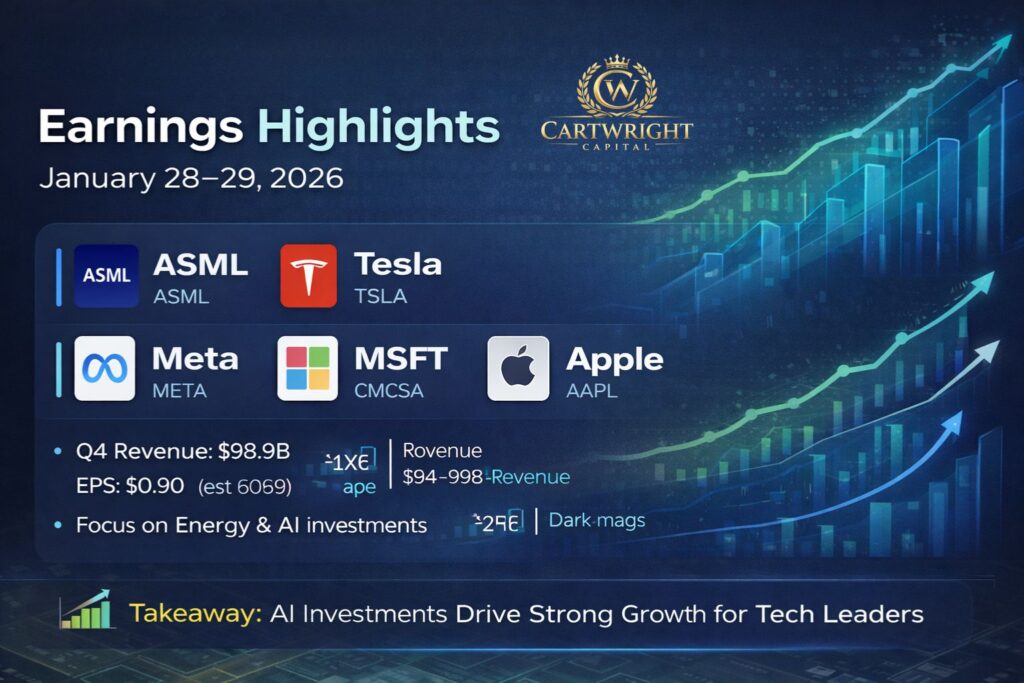
Date: January 28–29, 2026
The final days of January brought one of the most closely watched earnings windows of the quarter. Several global market leaders across technology, semiconductors, automotive, media, and communications reported their latest results, offering valuable insight into corporate profitability, capital allocation, and strategic direction as we enter 2026.
Companies such as ASML, Tesla, Meta Platforms, Microsoft, Comcast, and Apple collectively shape investor sentiment—and their earnings this week clearly underline one dominant theme: AI-driven investment and capital intensity are redefining the market landscape.
Below is a structured overview of the most important earnings releases from January 28–29, 2026.
ASML (ASML) – Semiconductor Backbone of the AI Cycle
Reported: January 28, 2026 (Pre-Market)
ASML delivered one of the strongest reports of the season, confirming its role as a critical supplier to the global semiconductor ecosystem.
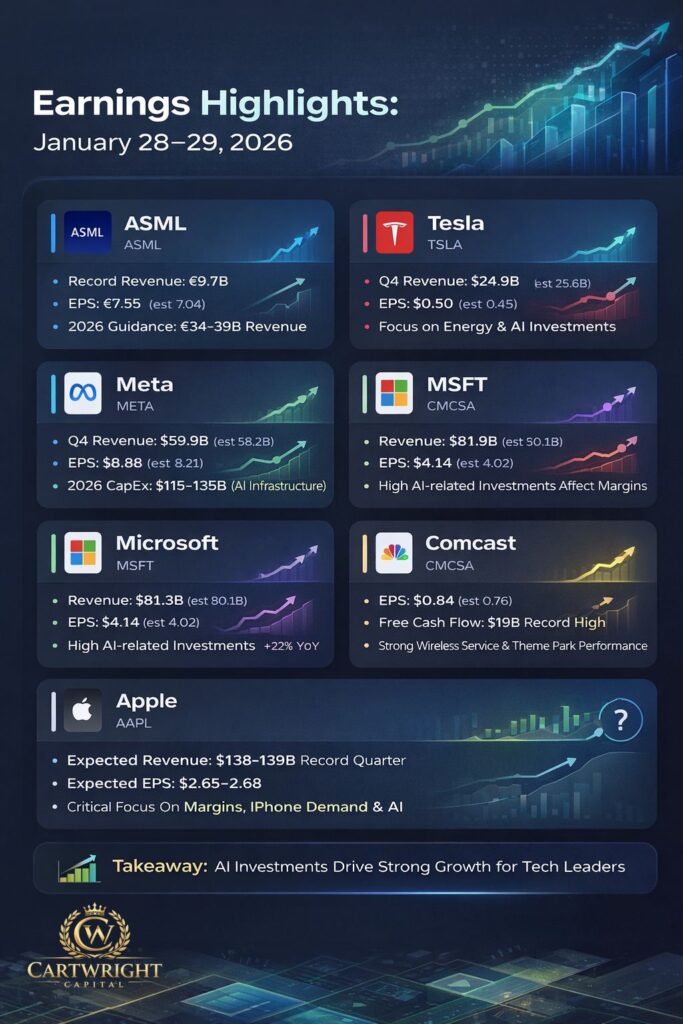
- Q4 2025 Revenue: €9.7 billion (record level)
- Q4 2025 Net Income: €2.8 billion
- FY 2025 Revenue: €32.7 billion (+16% YoY)
- FY 2025 Net Income: €9.6 billion
- Q4 Bookings: €13.2 billion
- Order Backlog: €38.8 billion
- 2026 Guidance: €34–39 billion revenue, gross margin 51–53%
ASML also announced an expanded share buyback program totaling €12 billion and increased shareholder returns via dividends.
Cartwright Capital view:
ASML’s results confirm that AI-driven demand is not a short-term narrative but a structural trend. The company’s backlog and forward guidance provide rare visibility in an otherwise uncertain macro environment.
Tesla (TSLA) – Transition Phase Between EVs and AI
Reported: January 28, 2026 (After Market Close)
Tesla’s results exceeded consensus expectations but highlighted an ongoing transition in its business model.
- Q4 2025 Revenue: ~$24.9 billion
- EPS: $0.50 (above consensus)
- Automotive Revenue: Declined year-over-year
- Energy Segment: Strong growth
- Margins: Stabilizing after prior compression
Management emphasized continued investment in autonomous driving, robotics, and AI infrastructure, while traditional EV growth remains under pressure.
Cartwright Capital view:
Tesla is increasingly valued less as a pure automotive company and more as a long-duration AI and energy platform. Execution risk remains, but strategic optionality is significant.
Meta Platforms (META) – AI at Full Scale
Reported: January 28–29, 2026
Meta delivered a standout earnings report, beating expectations on both revenue and profitability.
- Q4 2025 Revenue: ~$59.9 billion (+24% YoY)
- EPS: ~$8.88 (above estimates)
- Q1 2026 Guidance: Above market expectations
- 2026 CapEx Plan: $115–135 billion, primarily AI-related
The company continues to benefit from strong advertising demand while aggressively scaling AI infrastructure.
Cartwright Capital view:
Meta’s earnings reinforce a clear message: advertising monetization and AI investment are no longer competing priorities—they are mutually reinforcing.
Microsoft (MSFT) – Strong Numbers, Cautious Market Reaction
Reported: January 28, 2026 (After Market Close)
Microsoft once again posted solid financial results, though market reaction was mixed.
- Q2 FY2026 Revenue: ~$81.3 billion
- EPS: ~$4.14 (above consensus)
- Azure & Cloud: Continued growth
- Concern: Margin pressure and rising AI-related costs
Despite operational strength, investors remain sensitive to capital intensity and near-term margin dynamics.
Cartwright Capital view:
Microsoft remains one of the most strategically positioned AI platforms globally. Short-term margin concerns do little to undermine its long-term competitive moat.
Comcast (CMCSA) – Cash Flow Strength Amid Mixed Operations
Reported: January 29, 2026 (Pre-Market)
Comcast delivered a mixed earnings report, highlighted by strong cash generation.
- Q4 2025 EPS: ~$0.84 (above expectations)
- Revenue Growth: ~1% YoY
- EBITDA: Declined ~10%
- Free Cash Flow: Over $19 billion (record)
Growth in wireless services and theme parks partially offset pressure in legacy segments.
Cartwright Capital view:
Comcast remains a cash-generating machine, but structural challenges in media and broadband competition continue to cap valuation upside.
Apple (AAPL) – Earnings That Carry the Entire Market
Reported: January 29, 2026 (After Market Close)
Apple’s fiscal Q1 results were released after market close, making this one of the most anticipated earnings events of the season.
- Expected Revenue: ~$138–139 billion
- Expected EPS: ~$2.65–2.68
- Key Focus Areas: iPhone demand, Services margins, AI strategy
Apple’s earnings traditionally act as a macro signal for global consumer demand.
Cartwright Capital view:
With expectations extremely high, Apple’s results matter not just for its shareholders, but for overall market sentiment entering Q1 2026.
Key Takeaways for Investors
- AI CapEx dominates corporate strategy across technology leaders
- ASML stands out as a pure-play beneficiary of the AI hardware cycle
- Meta and Microsoft demonstrate different approaches to AI monetization
- Tesla’s valuation thesis is evolving, with less emphasis on vehicles alone
- Apple remains the ultimate sentiment driver for global equity markets
Final Thoughts
The earnings releases of January 28–29, 2026 confirm that markets are entering a phase where capital discipline, AI infrastructure, and long-term strategic positioning matter more than short-term margin fluctuations.
While not all companies delivered flawless results, the broader message is clear: corporate America is betting heavily on AI—and investors must decide which balance sheets can support that bet sustainably.
Disclaimer
This article reflects the author’s opinions and interpretations of publicly available information. It is not investment advice. Investing in commodities and financial markets involves risk, and readers should conduct their own research or consult a licensed financial advisor before making any investment decisions.
