f you’ve been following the oil market, you’ve likely noticed the growing nervousness at the start of this year. Oil prices are under pressure and headlines warn of massive oversupply. Is it time to panic—or could this be a rare buying opportunity? We took a closer look at what major Wall Street players are forecasting for 2026.
Consensus: A Year of Oversupply and Cheaper Oil
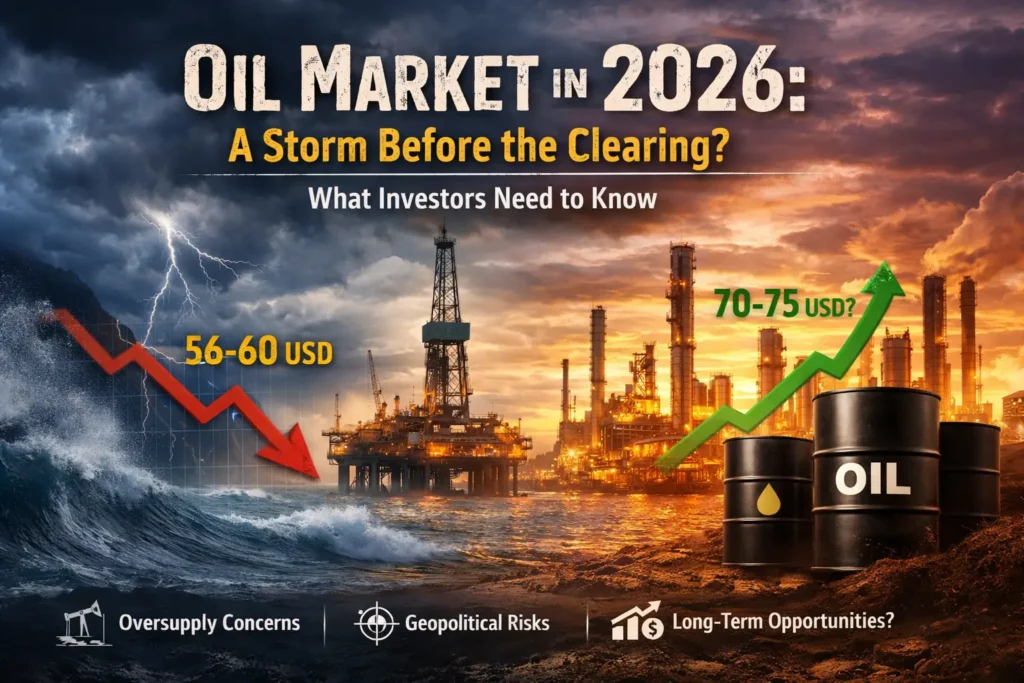
While UBS labels 2026 a “transition year” with an average Brent price around $62 per barrel, other institutions are even more cautious. Analysts from Goldman Sachs and Morgan Stanley warn that the “darkest hour” for oil may not be over yet.
- Goldman Sachs is among the most bearish, projecting average Brent prices as low as $56 per barrel, driven by a wave of supply from projects approved in previous years now hitting the market.
- Morgan Stanley recently cut its forecast for H1 2026, expecting prices between $55–57.
- JP Morgan aligns closely, with an estimate around $58.
The main driver is simple math: supply is growing faster than demand. Non-OPEC producers—especially the U.S., Brazil, Guyana, and Canada—are pumping record volumes, while demand growth in China has been weaker than expected, partly due to the rise of electric vehicles.
Light at the End of the Tunnel?
Not everything is bleak. UBS offers a key insight: 2026 may mark the cycle’s trough. The oversupply is expected to peak in Q1 2026, pressuring prices in the short term, but setting the stage for market rebalancing thereafter.
Why could the trend reverse?
- U.S. shale slowdown: If prices stay below $60, growth in U.S. shale production is likely to stall as new drilling becomes uneconomical.
- Recovery in 2027: Most banks, including UBS and Bernstein (which sees Brent at ~$65 this year), expect prices to rebound to $70–75 in 2027–2028.
The Wild Card: Geopolitics
Geopolitical risks remain a critical factor. Any unexpected disruption in supplies from Russia, Iran, or Venezuela could quickly erase the anticipated surplus. The IEA sees an oversupplied market but also warns that OPEC+ spare capacity could shrink rapidly in the event of political shocks.
What Does This Mean for Your Portfolio?
For investors in 2026, three core strategies stand out:
- Be cautious with pure producers: Companies heavily dependent on high oil prices and lacking hedging may face cash-flow stress in H1 2026.
- Quality over quantity: Focus on “oil aristocrats”—low-cost producers with break-even levels below $40–50 and strong balance sheets that can sustain dividends even in a low-price environment (e.g., majors like Exxon or Chevron).
- Long-term accumulation: If you believe in the cyclical nature of oil and UBS’s recovery thesis, price dips in Q1/Q2 2026 could offer attractive entry points for long-term positions.
Conclusion
2026 will be a test of investor nerves. The short-term outlook is weak, but history shows that periods of peak pessimism often create the best long-term opportunities.
Disclaimer
This article reflects the author’s opinions and interpretations of publicly available information. It is not investment advice. Investing in commodities and financial markets involves risk, and readers should conduct their own research or consult a licensed financial advisor before making any investment decisions.
Sources
UBS Global Wealth Management: Outlook 2026: Transition Year for Oil Markets
Goldman Sachs Research: Commodities Outlook 2026: Ride the Power Race
Morgan Stanley: Oil Price Forecast Revisions (Jan 2026)
IEA (International Energy Agency): Oil Market Report 2026
JP Morgan: Global Commodities Strategy
Investing.com: Market Analysis & Commodities News
