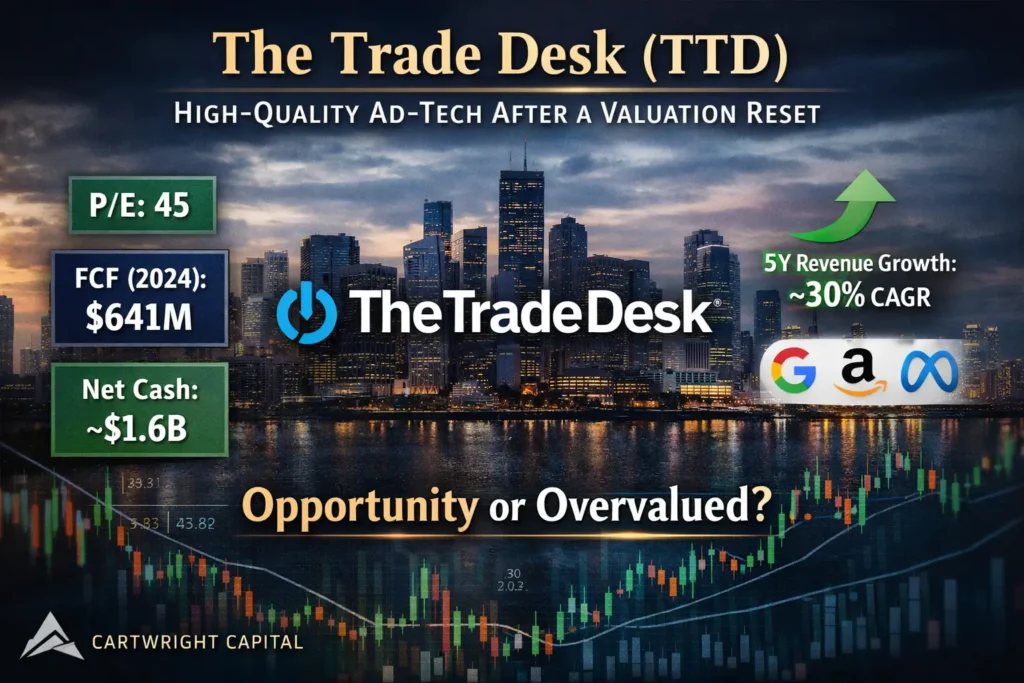
The Trade Desk is one of the strongest independent players in digital advertising, with a profitable business model, strong cash flow, and minimal debt. After a sharp valuation reset in 2025, the key question is whether TTD now offers an attractive long-term entry point—or if the stock still embeds too much optimism.
The Trade Desk (TTD) is one of the most important independent players in digital advertising. It operates a leading demand-side platform (DSP) that helps advertisers and agencies buy ads programmatically across the open internet—including Connected TV (CTV), display, mobile, and audio.
After a major valuation reset in 2025, TTD is no longer priced like a “perfect” growth stock. The key question is simple:
Is TTD now a compelling long-term opportunity—or still too expensive given its risks?
This post summarizes the core fundamentals, financial strength, valuation, and the biggest risks. The full long-form analysis is available in the linked document.
Fundamental Snapshot of The Trade Desk (TTD)
1) Quantitative Screening Metrics
Valuation
- P/E (TTM): ~45
- Forward P/E: ~21–36 (range depends on assumptions / forward EPS)
- PEG: ~1.0–1.2
- P/B: ~7.4
- P/S: ~6.9
- EV/EBITDA: ~28.5
- P/FCF: ~28 (implied ~3.6% FCF yield)
Profitability & returns
- Gross margin: ~79%
- Operating margin: ~19%
- Net margin: ~16%
- ROE: ~16.8%
- ROIC: ~15%
Balance sheet / liquidity
- Debt/Equity: ~0.14
- Debt/EBITDA: ~0.5x
- Current ratio: ~1.7
- Net cash (2024): ~+$1.6B
(cash & investments ~$1.92B vs debt-like obligations ~$312M)
Growth (historical)
- 5Y revenue CAGR: ~30%
- 5Y EPS CAGR: ~28%
Dividend
- 0% (TTD reinvests; no dividend)
What it means:
TTD is not “cheap” on classic value metrics, but the balance sheet is exceptionally strong, and the company remains highly profitable with strong historical growth.
2) Financial Performance and Stability
Revenue growth
- Revenue expanded from $308M (2017) to $2.44B (2024)
- Trailing revenue reached roughly $2.79B (TTM to Q3 2025)
Net income
- ~$393M (2023) → ~$393M (2024)
- ~$439M (TTM to Q3 2025)
Free Cash Flow (FCF)
- $331M (2020)
- $324M (2021)
- $465M (2022)
- $552M (2023)
- $641M (2024)
What it means:
TTD is not just a “story stock.” It produces real and growing cash flow, while maintaining strong margins.
3) Qualitative Factors
Business model
TTD’s DSP enables advertisers to buy ad inventory across the open internet, typically collecting a platform fee tied to ad spend. Its strength is independence—many clients want transparency and control outside closed ecosystems.
Competitive advantage
TTD’s edge is built around:
- Scale + data-driven optimization (better performance improves retention)
- Deep integrations and ecosystem connectivity
- AI-driven decisioning (platform improvements aimed at campaign ROI)
- Strong customer stickiness (high retention historically reported)
- Strategic positioning in CTV, one of the fastest-growing ad channels
Industry backdrop
Digital advertising is large and still growing. The CTV shift (traditional TV budgets moving to streaming) is a major long-term tailwind.
Management & governance
- Founder/CEO Jeff Green holds about ~8–9% economic ownership
- Dual-class voting structure gives him roughly ~53% of voting power
- Institutional ownership is high (~75%), with major holders including Vanguard and BlackRock
What it means:
TTD is widely viewed as a high-quality, founder-led compounder—but the voting structure concentrates control.
4) Intrinsic Value Lens (High-Level)
TTD’s intrinsic value is highly sensitive to future growth assumptions.
- With FCF ~ $641M (2024) and continued growth, a reasonable set of assumptions often produces an intrinsic value range around today’s market cap to moderately higher.
- Under stronger growth and operating leverage, upside can expand meaningfully.
- Under slower growth (or multiple compression), downside remains possible even with strong fundamentals.
What it means:
This looks less like a deep value bargain and more like “high quality at a more reasonable price” after the reset.
5) Risks (What Could Go Wrong)
- Valuation risk: even after the drawdown, multiples remain elevated vs traditional “value.”
- Ad cycle risk: advertising budgets can tighten in recessions.
- Platform power: Google/Amazon/Meta influence data, inventory, and rules.
- Privacy & regulation: tracking limitations can pressure ad efficiency.
- Governance concentration: dual-class voting reduces minority shareholder influence.
What it means:
TTD’s risk is not balance-sheet fragility—it’s expectations and market re-rating.
6) Conclusion
The Trade Desk appears to be a financially robust company with:
- strong cash generation (FCF ~$641M in 2024),
- minimal leverage (Debt/Equity ~0.14),
- high margins (gross ~79%),
- and a compelling long-term positioning in the open internet and Connected TV.
However, TTD is not a classic low-multiple value stock. The investment case depends on whether you believe TTD can sustain high-quality growth long enough to justify premium multiples—especially after the 2025 reset made valuation far less extreme than in prior years.
Sources
- Company annual & quarterly reports
- Yahoo Finance, Finviz, StockAnalysis (market metrics & ratios)
- Analyst consensus and industry commentary
Disclaimer: This article is for informational and educational purposes only and reflects personal analysis and opinions. It does not constitute financial, investment, or trading advice. Always do your own research and consider your individual circumstances before making any investment decisions.
